
Part I · Chapters 1–3
Stay
Be present. The first ten minutes, listening that holds, and the words you choose — in person, on the phone and by text.
First-Response Care for Church Leaders
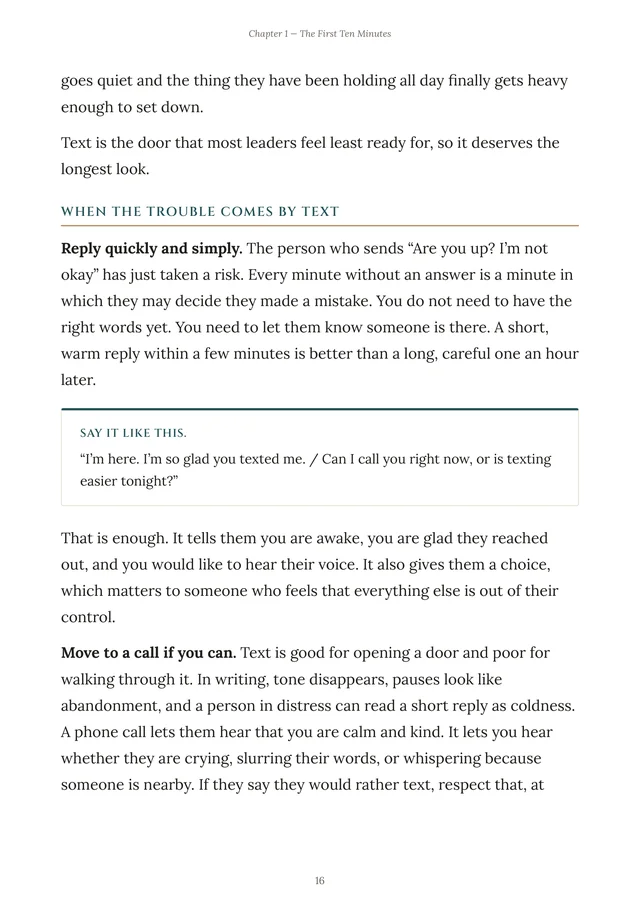
It may be a text late at night — “Are you awake? Can I call you?” — or a quiet “Do you have a minute?” after group. People bring their trouble to the leader they trust, not the one with the degree. This book gives you the first ten minutes, the words to use and the words to avoid, and a clear line where your part ends and someone else's begins.
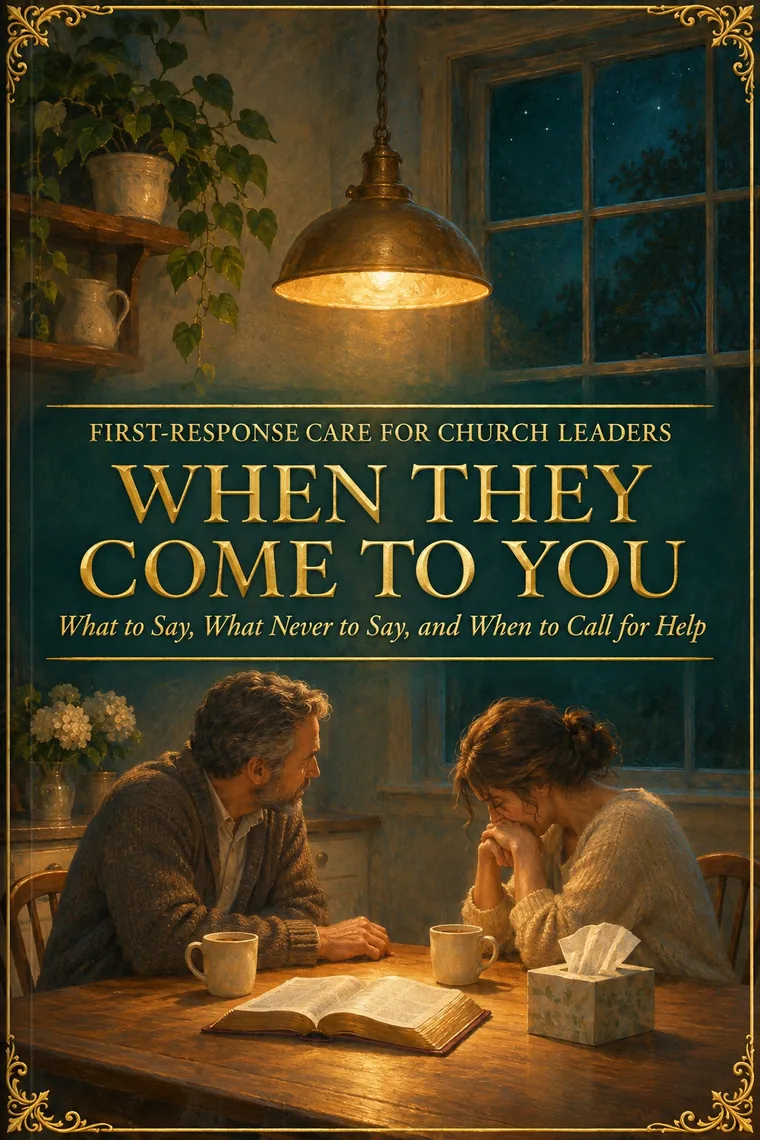
The Moment Nobody Trained You For
You know the face: someone you have known for years, looking at you in a way you have not seen before. In that moment most leaders feel two things at once — honored to be trusted, and afraid of saying the wrong thing.
“Everything happens for a reason.” “I know exactly how you feel.” Kind people say them every week, and watch the person they meant to comfort quietly close up.
Is this grief you can sit with for weeks, or something you must never carry alone? Without a line, leaders either try to fix everything or slowly back away.
A text at night, a call while you're driving, a word in the parking lot after church. There is no time to look anything up. You need to know it already.
People don't bring their trouble to the person with the right job title. They bring it to the person they trust and can reach. If you have been faithful and kind for long enough, that is you.
Four Words for Every Hard Conversation
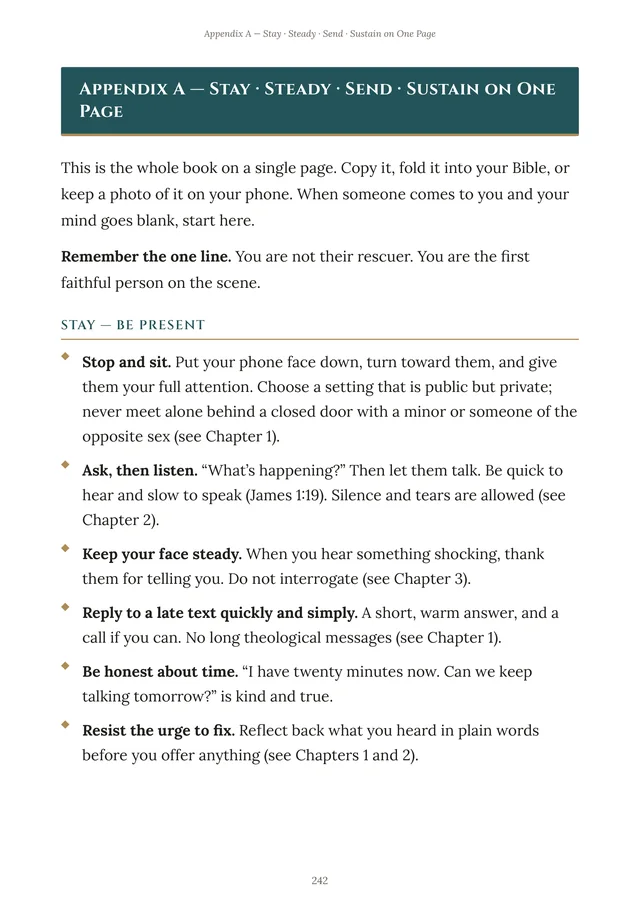
The whole book hangs on four words, so you can remember them when your mind goes blank.
Part I · Chapters 1–3
Be present. The first ten minutes, listening that holds, and the words you choose — in person, on the phone and by text.

Part II · Chapters 4–5
Give them footing. Scripture and prayer, offered gently, at the right moment, and never thrown at someone in pain.

Part III · Chapters 6–9
Connect them to more help than you are — your pastor, a doctor or counselor, and in an emergency, 911 — without handing them off.

Part V · Chapter 12
Keep caring over the weeks that follow, and keep yourself whole enough to keep doing it.
You are not their rescuer. You are the first faithful person on the scene.
The one sentence the book comes back to. You do not have to fix what is broken. You have to show up, stay calm, love them well for an hour, and make sure they are not left alone with what is too big for both of you.
Why This Book Is Different
Every chapter has “Say it like this” boxes: short, natural sentences for the hallway, the phone call and the reply to a late-night text. Not a script — a place to start in your own voice.
Seven situations no lay leader should handle alone, each in the same calm, plain format: what you might hear, what to do in the next ten minutes, who to call, and what never to do.
No therapy techniques, no labels for anyone, no side in the debates between counseling schools. Just what a faithful friend does in the first hour, the next forty-eight hours and the weeks after.
A Look at Chapter 3
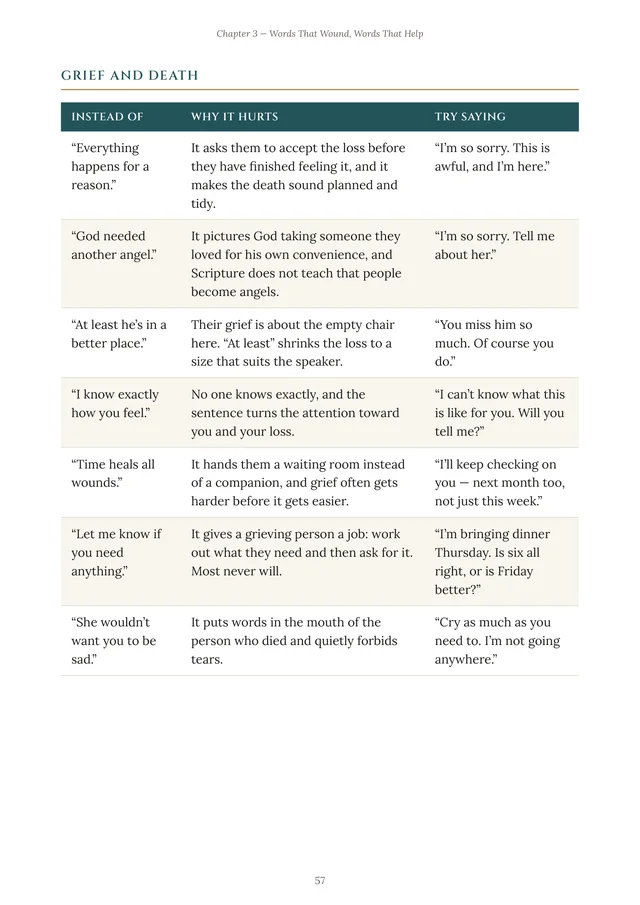
Chapter 3 lists 46 things people commonly say to those who are suffering, many of them said in church by kind people. Beside each: why it tends to hurt, and something you could say instead. Here are six.
Grief and death
“Everything happens for a reason.”
It asks them to accept the loss before they have finished feeling it.
“I'm so sorry. This is awful, and I'm here.”
Grief and death
“Let me know if you need anything.”
It gives a grieving person a job: work out what they need and then ask for it. Most never will.
“I'm bringing dinner Thursday. Is six all right, or is Friday better?”
Illness and diagnosis
“God doesn't give us more than we can handle.”
It misreads a verse about temptation and suggests that if they feel overwhelmed, they are failing.
“This is more than anyone should have to carry. You don't have to carry it alone.”
Depression and anxiety
“Just pray more.”
Many who are depressed have prayed until they ran out of words.
“Can I pray for you? You don't have to find the words yourself right now.”
Children and prodigals
“Where do you think you went wrong?”
It is a verdict dressed as a question. Parents already ask it of themselves at three in the morning.
“What's been the hardest part for you?”
Job loss and money
“When God closes a door, he opens a window.”
It is not in the Bible, and it hurries them past a real loss toward a next thing that has not appeared yet.
“Losing a job hits more than the paycheck. How are you holding up?”
The point is not guilt. The point is a better sentence next time.
Chapter 6 · Read This First
Most of what comes to you will be grief, worry, conflict and the ordinary weight of life — things you can sit with, pray over and follow up on for weeks. A few moments are different in kind. Chapter 6 names them plainly, so that when one arrives on a weeknight you are not starting from nothing. It protects the person in front of you, and it protects you.
Each one in the same plain pattern
Then: what to do while help is coming, what to write down afterward, what to tell your pastor, and how to build your help list before you need it.
What's Inside
Read Part I first, Chapter 6 before your next hard conversation, and keep Part IV for the evening a particular situation arrives.
Every chapter gives you
The first ten minutes — in person, by phone and by text. Listening that holds: silence, tears, and questions that open things up. Words that wound and words that help, group by group.
Scripture without wounding: the right verse at the right moment, and what to say when they ask “Why?” Praying with people in pain: ask first, keep it short, and what never to pray.
Read This First: the seven situations you never carry alone. What you can promise about confidentiality. The next forty-eight hours and the weeks after. Bringing in your pastor.
Grief and loss: the first week, the months after, and losses that need particular care. Marriage in crisis and addiction at home: listening to one side, love without enabling, where to send them.
Caring for the caregiver: what carrying other people's pain does to you, boundaries without guilt, who you talk to, and a seven-day reset.
The whole book on one page. Your help list, to fill in with your pastor. US crisis resources, with a line on when to use each. Conversation notes: what to write down, and what not to.
A Look Inside
Designed to be read in an evening and opened again the night someone calls.
Who It's For
No seminary needed. No counseling degree either.
You know your people's names, their kids and their prayer requests — so you are the one they text when something breaks.
You make the hospital visits and sit at kitchen tables. Chapter 9 shows how to bring in your pastor without dropping the person.
Ministry leaders hear about the affair, the diagnosis and the son who stopped calling before almost anyone else does.
Sunday-school teachers, associate and volunteer pastors: the ones who do much of a church's caring and get little of the training.
Super Bonus · The Hard Cases
When a particular situation arrives, open its case: what you hear, what may be behind it, what to do in four to six steps, words to say, what not to do, and who to send them to.
ALoss
BBody and Mind
CMarriage and Family
DHidden Struggles
EWhen Life Falls Apart
FFaith and the Church
Included Free — 191 More Pages, $49.94 of Extras
Three companion books and two pocket cards for the conversations the main book prepares you for — and a super bonus with twenty-four of the hardest ones, step by step.

The words themselves, for the conversations leaders dread. 60 pages.

Fifteen visits, each one written as something you can actually do. 46 pages.
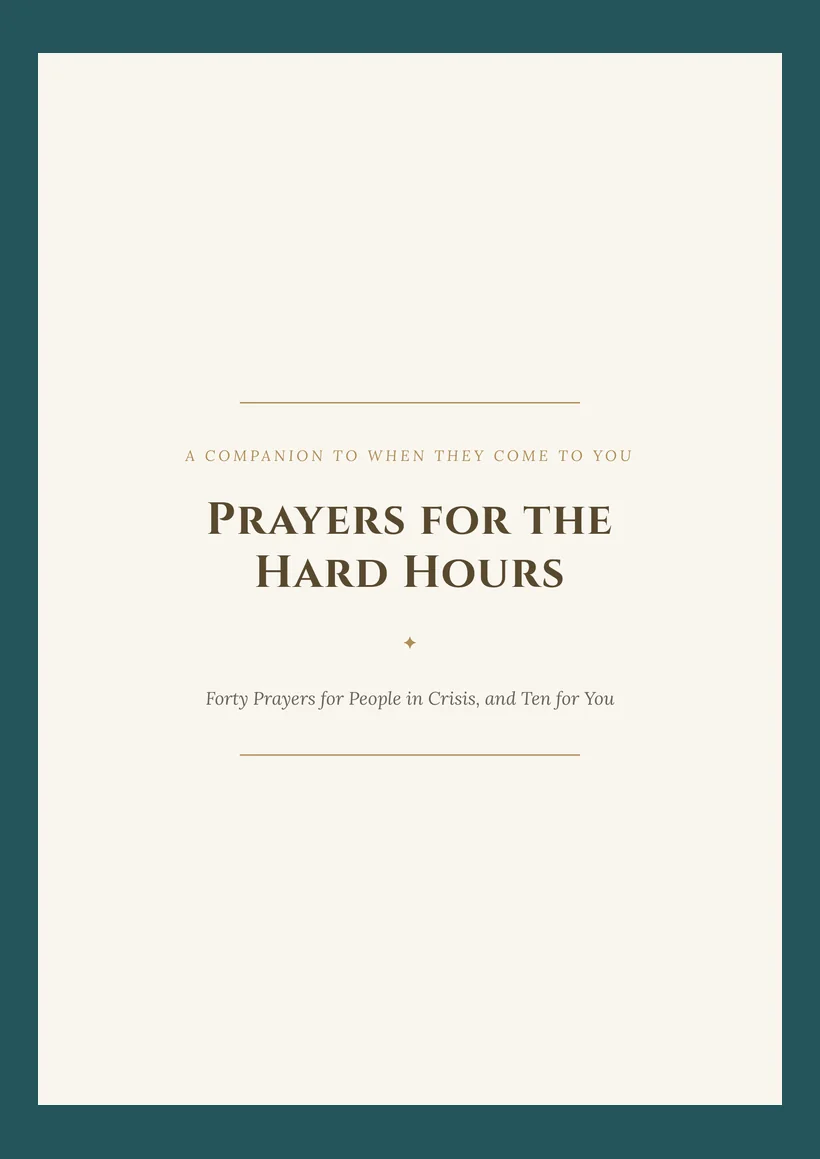
Short, plain and specific prayers for a hospital hallway or a phone call at night. 22 pages.
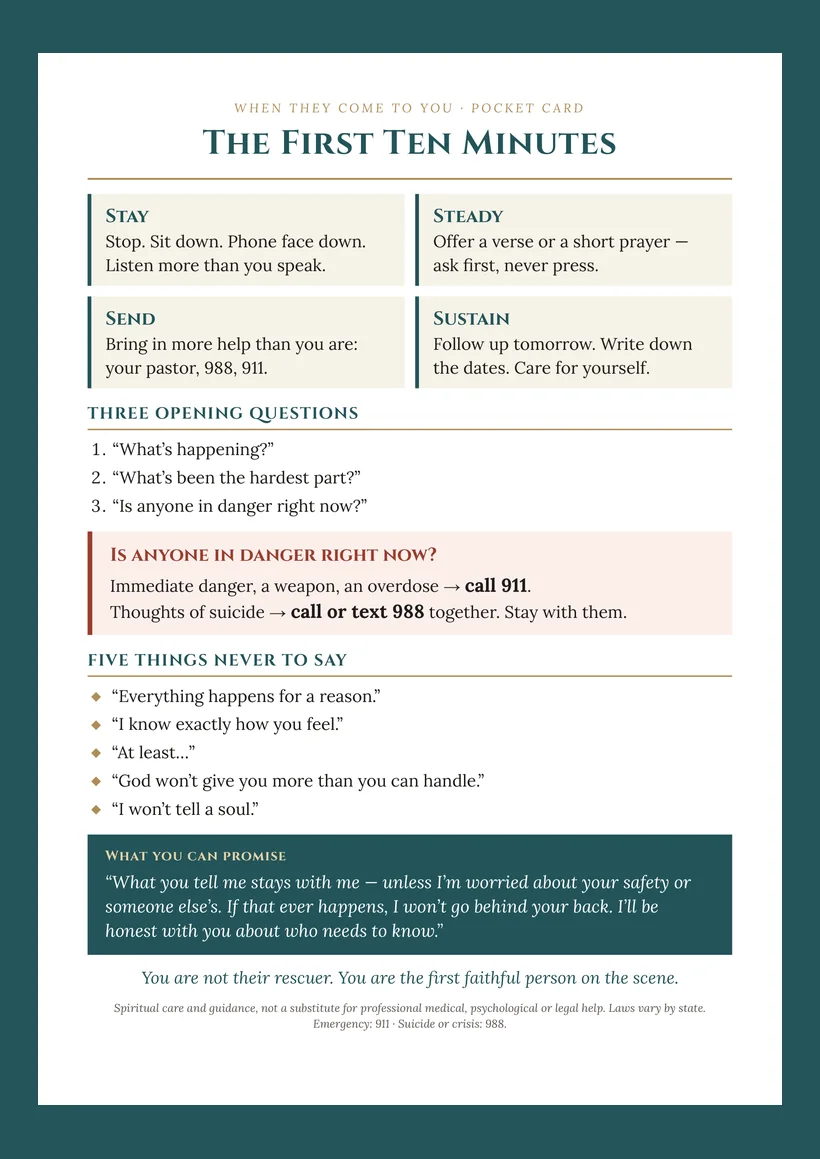
The whole first conversation on one printable page.
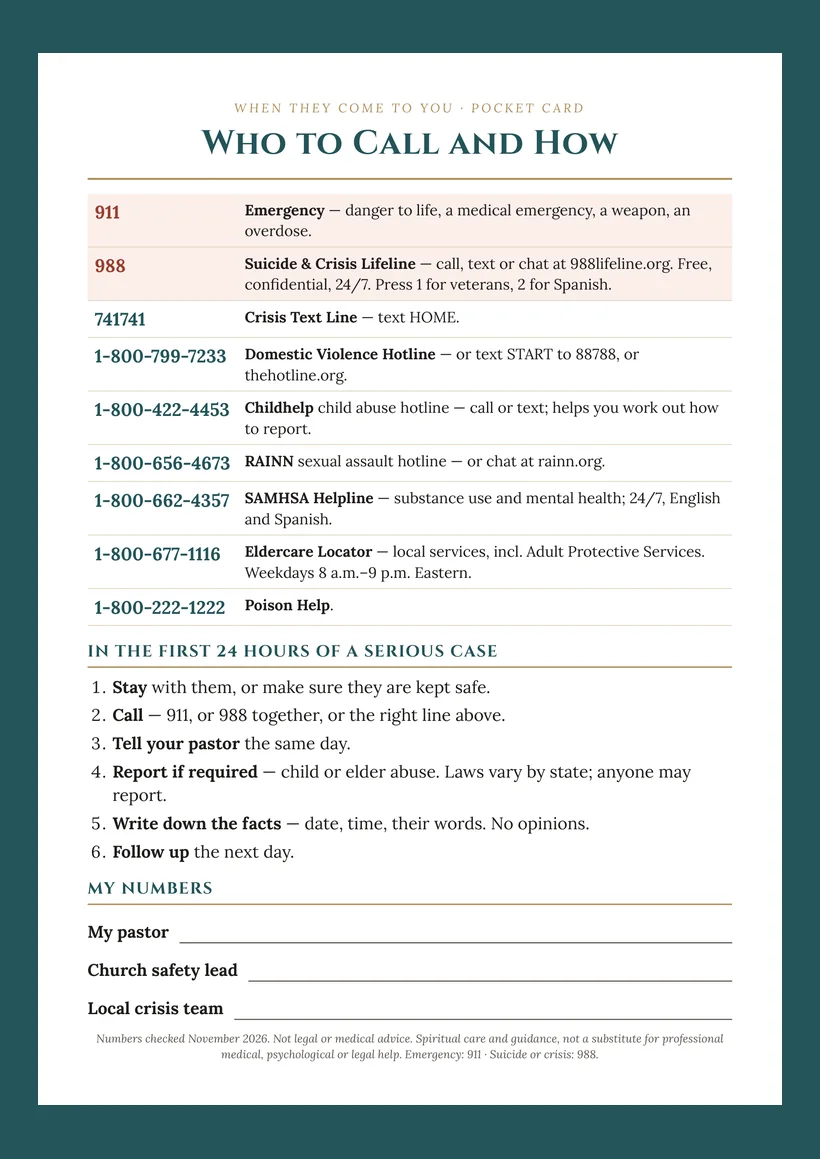
The numbers and the next steps, on one printable page.

Twenty-four situations in six groups, from a sudden death to a teenager who tells you something. 61 pages.
Each bonus book is valued at $9.99 and each pocket card at $4.99. All six — $49.94 together — come with the main book at no extra cost.
Get Your Copy
What to Say, What Never to Say, and When to Call for Help
What you get — and what it's worth
Launch price — the main book at 70% off, and all six bonuses ($49.94) free.
7-day money-back guarantee — zero risk
Secure payment via Hotmart. Instant PDF delivery.
Your Risk-Free Promise
Take a full 7 days. Read Part I and Chapter 6, and keep the two pocket cards by your phone. If it doesn't leave you calmer and clearer about what to say, request a refund — no questions asked. All the risk is on us, not you.
A Note to You
Every church has people others come to. Not because of a title, but because they are kind, faithful and close by. Sooner or later, one of them gets the message that starts with “Are you awake?” — and has no idea what to say next.
Most of them are not afraid of the work. They are afraid of making it worse: of saying the sentence that wounds, of missing something serious, of promising a secret they cannot keep.
So this book tries to do a plain thing: give an ordinary leader in an ordinary church the words for the first hour, a clear line where their part ends, and the confidence to stay — because the God of all comfort usually sends his comfort through people.
— The When They Come to You team
Instantly. Right after your purchase you can download all seven PDFs, and Hotmart emails you your access details as well. Nothing to wait for, and the files are yours to keep, with lifetime access.
Seven designed PDFs — 449 pages in total. They read well on a phone, a tablet or a computer with no special app, and the two pocket cards are made to print on a single page each.
No. It is first-response care: what a faithful friend and leader does in the first hour, the next forty-eight hours and the weeks after. It tells you plainly when someone needs their pastor, a doctor, a counselor or emergency help, and how to bring that help in without abandoning the person. It is not counselor training, and there is no certificate.
No. It is written for church leaders across traditions — Baptist, non-denominational, Methodist, Presbyterian, Pentecostal, Lutheran and others — and it takes no side in the debates between schools of counseling. It treats Scripture and prayer as real help, and it treats seeing a doctor or counselor as never a failure of faith.
Especially for you. It was written for small-group and Bible-study leaders, deacons and elders, men's, women's, youth and couples' leaders, Sunday-school teachers, and associate and volunteer pastors — the people others come to. No seminary needed.
It is far easier to learn the words before a hard conversation than during one. Read Part I and Chapter 6, and fill in the help list in Appendix B with your pastor. It takes an evening, and it is ready the night you need it.
Yes. Chapter 1 treats the three ways a crisis reaches you — in person, by phone and by text — with model words for each, including a first reply to a late-night message. The bonus What to Say in the Hard Moment opens with the text and the call that comes while you're driving.
The phone numbers in Appendix C and on the pocket card are for the United States. The care, the listening and the words apply wherever you are.
Yes. Every chapter ends with a short prayer and three questions made for a deacon board, an elders' meeting or a small-group leaders' huddle — one chapter a month works well. Teach from it freely; please don't share the PDFs themselves — each leader can get their own copy.
You're covered by a 7-day money-back guarantee. If it isn't a fit, request a refund within 7 days — no questions asked.
449 pages: Stay · Steady · Send · Sustain in 12 chapters, the Read This First chapter, and six bonuses — twenty-four hard cases, twenty-four conversations word for word, fifteen visits, fifty prayers and two pocket cards. Instant download, lifetime access, 7-day guarantee.
7-day guarantee • Secure checkout • Instant download